

Rheumatoid arthritis (RA) isn’t a common wear-and-tear arthritis. An autoimmune disease where the body’s immune system is confused and attacks the joints.
Some may experience stiff fingers in the morning. Some people experience swelling in their wrists or feel pain in their feet or are unable to move following waking from sleep. Many patients will start to look into other ways of treating their symptoms, and begin asking themselves if homeopathy can help.
With rheumatoid arthritis, I don’t look at two patients simply as having the same diagnosis. Their symptoms, triggers, daily difficulties, and overall health can be quite different. That individual picture is important when we discuss any complementary approach.”- Origin Homoeopathy
Understanding Rheumatoid Arthritis Before Looking at Treatment

RA commonly affects the smaller joints of the hands, wrists and feet. It often affects joints on both sides of the body.
Some common symptoms include:
- Morning stiffness that lasts for a while
- Swollen or tender joints
- Pain that comes and goes during flare-ups
- Reduced movement in the affected joints
- Tiredness or a general feeling of being unwell
- Symptoms that may become worse during periods of increased disease activity
RA is an inflammatory disease, so leaving active inflammation untreated can allow joint damage to develop over time.
How Conventional Medicine Approaches RA
No single treatment will work for everyone with RA.
Treatment is typically decided based on disease activity, symptoms, laboratory tests and any risk of joint damage; this is determined by the rheumatologist.
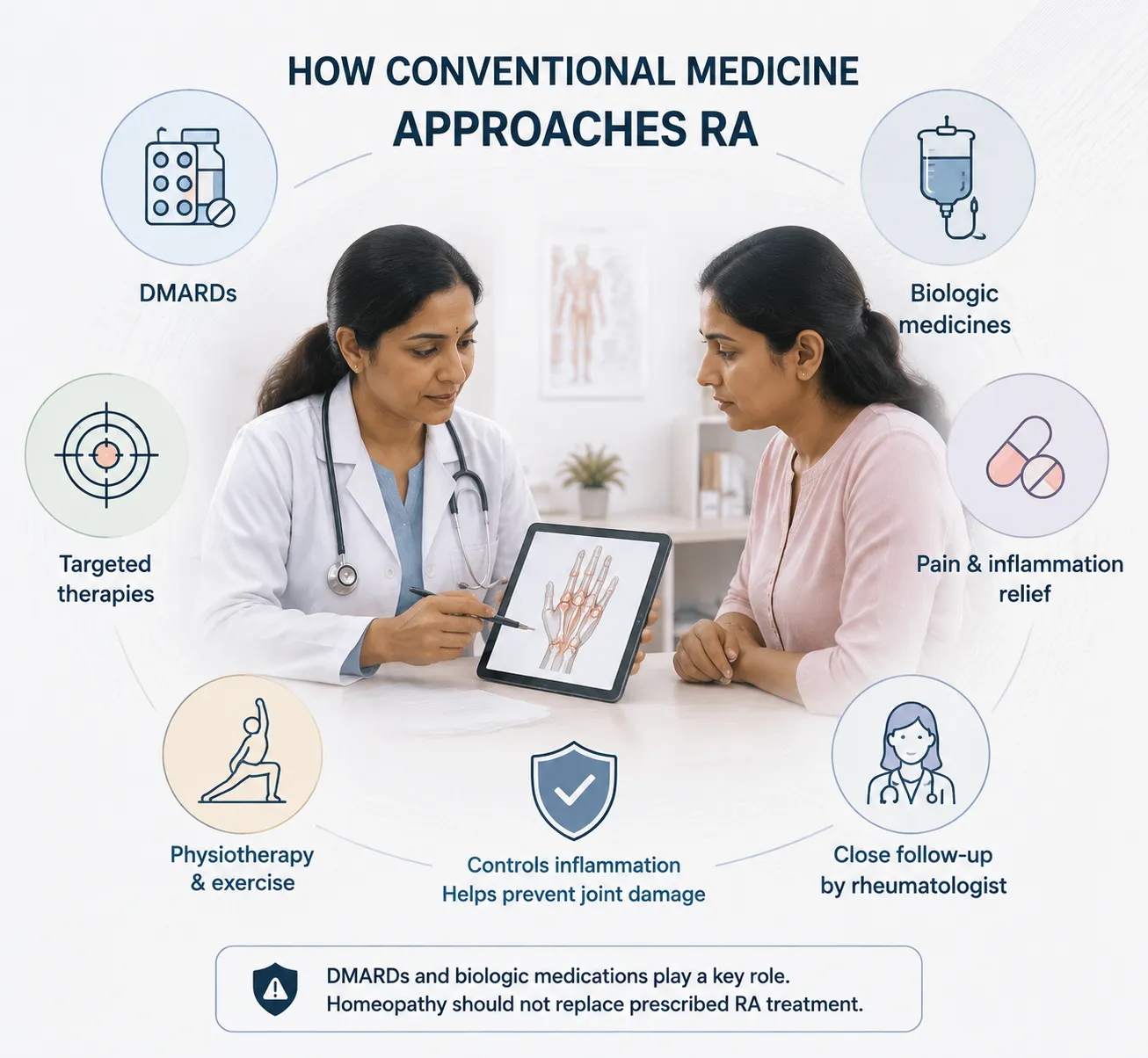
- Treatment is likely to involve
- Medications that modify the disease (DMARDs)
- Biologic medicines
- Targeted therapies
- Medicines to control pain and inflammation
- Physiotherapy and suitable exercise.
- Close follow-up by a rheumatologist
The use of DMARDs and biologic medications has an important role, as they can help control inflammation and help to prevent long-term joint damage.
However, some patients are interested in complementary approaches because they wish to manage their symptoms and/or prefer a more personalized approach to their overall care.
What Does the Research Say About Homeopathy for RA?
Let’s be honest about the evidence here, because homeopathy and RA is a topic where it’s tempting to oversell things. There have been a handful of small clinical trials and observational studies looking at homeopathic remedies for RA pain and stiffness, and some did show improvement over placebo. That’s worth mentioning. But most of these studies were small, and honestly, the methodology often doesn’t hold up to the standards rheumatology research normally requires. So we’re not going to call this proven preliminary is the more honest word.
There’s also something harder to measure: the experience homeopaths build up over years of actually treating patients. Real patterns, real observations, just not the kind of thing that gets validated in a controlled trial. We don’t think that makes it worthless, but it’s a different category of evidence, and pretending otherwise doesn’t help anyone.
Here’s what matters most, though. RA doesn’t wait around. It’s a progressive disease, and the joint damage it causes is permanent once it happens. So none of this is a case for skipping the treatment a rheumatologist would actually prescribe. If homeopathy fits anywhere, it’s as something alongside that care maybe helping with comfort day to day never as a replacement for it.
Curious whether this kind of individualized approach fits into how you’re currently managing RA? Book a consultation to talk through your specific case.
How Classical Homeopathy Approaches RA Differently
That case-taking process is really what separates classical homeopathy from a symptom checklist. Two RA patients might come in with similar joint involvement but completely different underlying pictures one whose flares track closely with stress, another where cold weather is the consistent trigger. The remedy selection follows from that pattern, not from the diagnosis alone, which is the same principle behind how Origin Homeopathy approaches most chronic conditions, not just RA.
If you’re managing RA and wondering whether a more individualized, whole-person approach could complement what you’re already doing, Origin Homeopathy in Mehdipatnam offers consultations built around exactly that kind of case history.
Is Homeopathy Safe to Combine With Existing RA Medication?
Generally, yes. Homeopathic remedies don’t carry the drug-interaction risks that come with combining multiple pharmaceuticals, and they’re well tolerated across most age groups. Still, it’s worth keeping both your rheumatologist and your homeopath informed about everything you’re taking, just so nobody’s working with half the picture.
Ready to explore a personalized approach to managing your RA? Book your consultation with Origin Homeopathy today.
Frequently Asked Questions
Can homeopathy cure rheumatoid arthritis?
No treatment, homeopathic or conventional, can currently claim a cure for RA. The aim with homeopathy is symptom management and, ideally, fewer flare-ups over time.
How long before I see results?
Varies by patient, but most chronic RA cases need several weeks to a few months of consistent treatment before changes become noticeable.
Can I continue my RA medication while trying homeopathy?
Yes, and it’s generally recommended you do, particularly if you’re on DMARDs or biologics. This works best as a complementary approach.
Is it safe long-term?
Generally yes, with a low side-effect profile, though it’s still worth keeping your doctors in the loop on everything you’re taking.